
What really makes a boutique hotel: size, character and the host
There is no legal definition, which is exactly why the word gets stretched. Here is how to recognise the real thing, from the welcome at the door to the breakfast table.
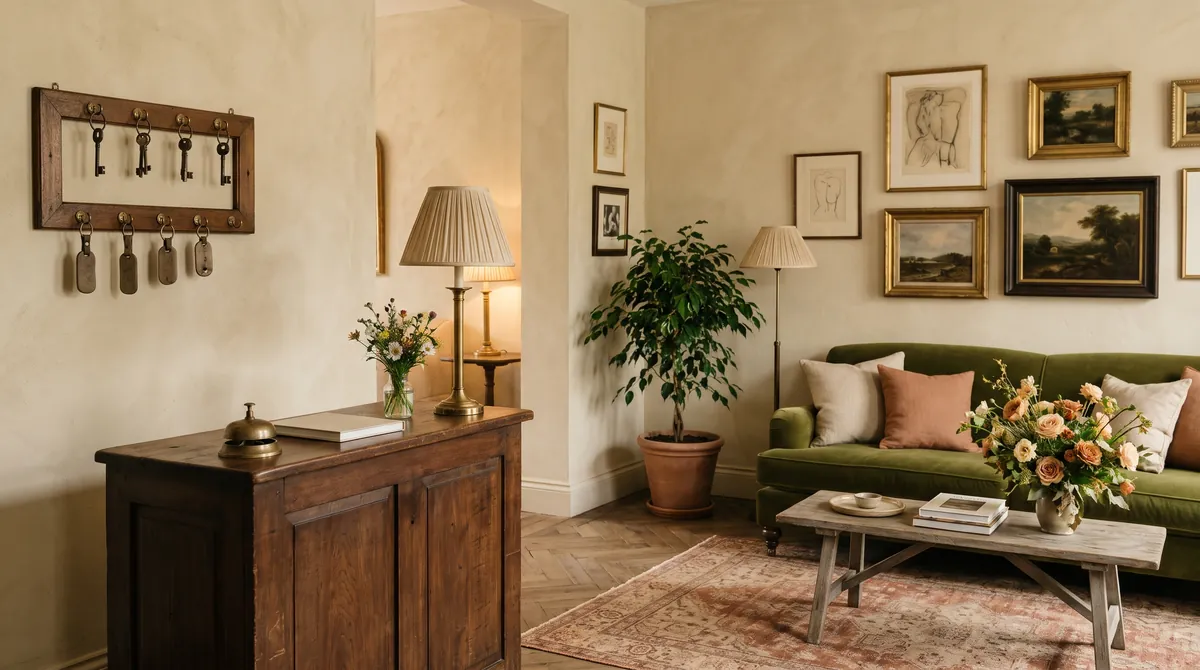
It is late afternoon when you push open the heavy wooden door. Inside, the noise of the street falls away, a fountain murmurs in a patio lined with potted geraniums, and the light comes down soft and grey-gold through a canvas awning. A woman comes out of the kitchen drying her hands, greets you by name and remembers that you asked about walks. She gives you an iron key, not a card. Nobody has said the word boutique, and nobody needs to: that moment tells you more than any label could.
A word that nobody owns
There is no legal definition of a boutique hotel. The term is generally used for small, independent hotels with an individual design, a strong sense of place and personal service. They usually have a limited number of rooms, often fewer than about 50, and many have far fewer, sometimes just six or eight around a courtyard. Because nobody owns the word, it stretches easily. A large group can call its newest building boutique, while a family house with a handful of rooms in a Mallorcan village may never use the term at all. So it pays to look past the label to what lies behind it.
Boutique, design, guest house or country house?
The words overlap, and the best places are often two things at once. Still, each has its own centre of gravity, and knowing it helps you read a description with clearer eyes.
| Kind of stay | What defines it | What to expect |
|---|---|---|
| Chain hotel | A brand standard that repeats from city to city | Predictable rooms, long reception hours, few surprises either way |
| Design hotel | Mainly its architecture and interior | Striking spaces; the character comes from the designer more than from the place |
| Boutique hotel | Small, independent, individual and rooted in its place | Personal service, rooms that differ, a host who shapes the stay |
| Guest house or bed and breakfast | Often run by the owners in their own home | A very personal welcome, house rules, breakfast close to the family kitchen |
| Country house hotel | A house standing in its own grounds | Gardens, quiet, a dining room that becomes the evening |
The lines blur: a design hotel can be small and independent, and a guest house can feel like a boutique hotel.
In southern Europe the categories blur in the most charming ways. A casa palacio in Seville, the town house of an old family arranged around a patio, may now be a boutique hotel with a design-minded interior. A quinta in the Douro valley, a country estate among terraced vineyards, often works like a country house hotel. A masseria in Puglia, a fortified farmhouse of pale stone, can be as personal as a guest house. What matters is less the category than two simple questions: is it independent, and does it feel as if it could only exist in this place?
Signs you have found the real thing
None of these signs needs luxury. Some of the most memorable small hotels are quite simple; what they share is attention.
- The host knows your name. Not because a screen says so, but because they read your message and remember what was in it.
- Local materials and craft. Hand-made tiles, lime-washed walls, old beams, linen, terracotta floors that stay cool under bare feet, furniture made by someone in the next valley.
- A breakfast that tastes of the region. Oranges squeezed that morning, olive oil from nearby groves, local cheese and honey; toast with grated tomato in Andalusia, ensaïmada in Mallorca, pastéis de nata in Portugal.
- Somewhere to be that is not your room. A library with books left behind by other guests, a garden with a bench in the shade, a roof terrace for the evening.
- A room that feels lived in. Reading lamps where you actually read, a jug of water, pictures by local painters rather than anonymous prints.
- Recommendations beyond the obvious. The bakery that opens at seven, the chapel to walk to at sunset, the day of the weekly market, the beach to skip in August.
A good boutique hotel is not a smaller version of a big hotel; it is a different idea of what a stay should be.
What a small house does differently
Character comes with trade-offs, and it is better to know them before you arrive than to discover them at eleven at night. Expect fewer facilities: perhaps no gym, no room service late in the evening, and a pool that is more a place to cool off than to swim lengths, or no pool at all. Very small houses often have no 24 hour reception. The owners may live upstairs or in the village; they will ask for your arrival time and leave a key or a code if you come late.
In historic buildings, rooms can be very different in size. The former grain store may be twice as large as the little room under the roof, and a carmen in Granada’s Albaicín, a house with a walled garden on the hillside, may spread over several levels joined by steep stairs. Many small hotels also close for some weeks or months in winter, especially on the coast and in the countryside. None of this is a fault. It is simply part of staying in a house that was not built as a hotel.
How to read the photos
Hotel photos are chosen to seduce, which is fair, but they leave things out. A wide-angle lens can make a small room look generous, so look for a picture in which a bed, a chair or a door gives you a sense of scale. Count the windows and notice which way they face. A terrace in the gallery may belong to one suite or be shared by everyone, and the view from the pool is not necessarily the view from your room. A photograph taken in the golden hour also tells you little about the light at noon.
Notice what is missing, too. If every corner of the garden appears but no bathroom does, ask about the bathroom. Photos taken by guests are usually less flattering and more honest: they show the rooms in ordinary daylight and how worn the furniture really is.
How to read the reviews
Skip the very best and the very worst reviews and start with the ones in the middle, which tend to be the most balanced. Look for patterns rather than single complaints. If several guests mention street noise, believe them; if several mention the host by name, that is one of the best signs a small hotel can have. A breakfast described in loving detail is another. Read the replies from the house as well, because a calm, personal answer to criticism shows you how problems are handled while you are there.
Some complaints are really information. “No lift” and “nobody at reception after eight” are not faults in a small historic house, but they matter if you travel with heavy luggage or arrive late. Read reviews written in the season you plan to travel, because a garden hotel can feel like two different places in April and in August.
Questions to ask before you book
- Who runs the house day to day, and will they be there during our stay?
- Until what time is someone at reception, and how do we get in if we arrive late?
- Which rooms are in the oldest part of the building, and how do they differ?
- What does breakfast include, and where do the ingredients come from?
- Is the hotel open all year, and what is still open in the village in our season?
- What would you recommend that most guests miss?
A specific, unhurried answer, signed by a real person, is itself a good sign. Remember that many small hotels are family homes as well as businesses: a short, friendly message is always welcome, a long list of demands much less so.
The southern way of doing it
Each region of the south has its own version of the idea: the patio house of Seville, the stone possessió of Mallorca among olive terraces, the herdade surrounded by cork oaks in the Alentejo, the agriturismo on a Tuscan hillside, the mas or bastide of Provence with plane trees by the door. The architecture differs, but the best of them share one quality. You leave knowing a little more about the place, and the place knows a little about you.
Questions and answers
Is a boutique hotel always expensive?
No. The word describes size, independence and character, not a price level. Some of the most memorable small hotels are simple and modest, while some costly hotels have very little character at all.
Is a design hotel the same as a boutique hotel?
Not necessarily. A design hotel is defined mainly by its architecture and interior and can belong to a chain. A boutique hotel may be beautifully designed, but what defines it is being small, independent and rooted in its place.
Do boutique hotels have a 24 hour reception?
Larger ones often do, very small ones often do not. The owners may live on site or nearby and leave a key or a code for late arrivals. Tell them your arrival time and ask how to reach them in the evening.
Are boutique hotels suitable for families?
Many are, some are not. Steep stairs in historic buildings, small pools and quiet dining rooms suit some families better than others, and some houses only take adults. Ask the host honestly what the house is like with children.
Further reading in our network
- HotelrisHotel magazine
Stories from the world of hotels and hospitality, from small family houses to the people who run them.
Our articles are general travel information written with care. Opening months, access and local rules change; check the details with your hotel before you travel.


