
Lake Como by boat: villas, gardens and slow crossings
On Lake Como the water is the main road. Leave the car, take the ferries, and the villas, gardens and villages arrange themselves along the shore at the speed of a boat.
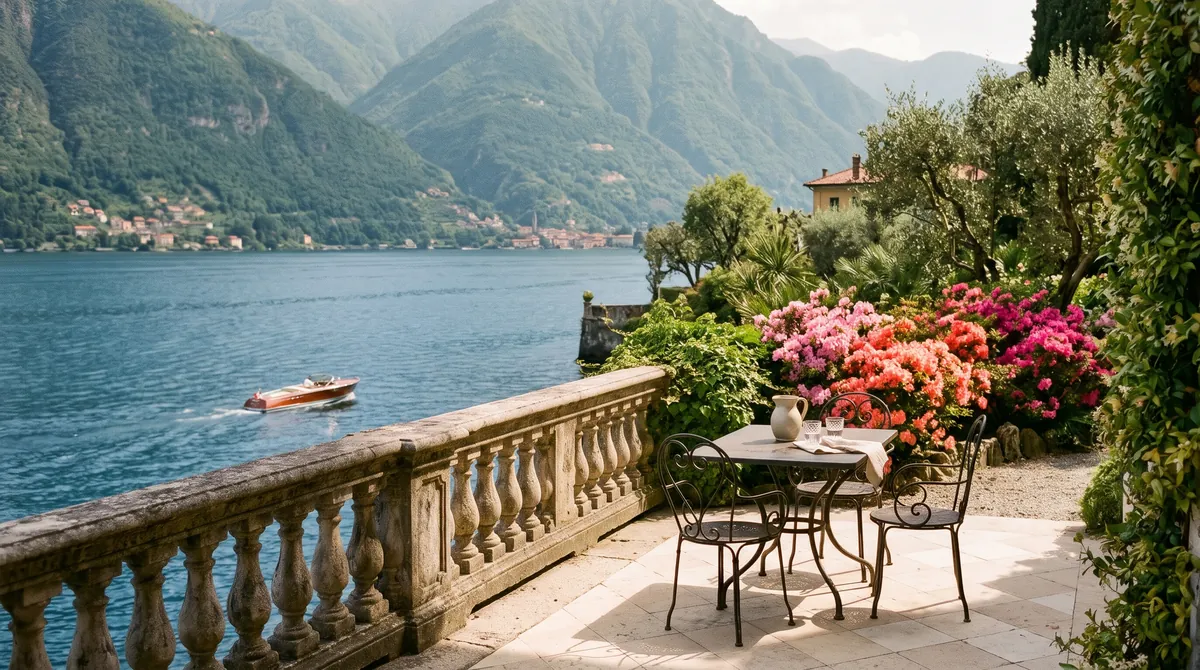
The boat comes in sideways, engines churning, and a sailor loops a rope around a bollard with a movement practised a thousand times. Passengers step off into a village square; others step on with shopping bags, a dog, a bunch of flowers. Then the boat pulls away and the shore slides past again: a church tower, an ochre villa with green shutters, a garden falling in terraces to the water, mountains rising so steeply behind that the houses seem to hold on with their fingertips. On Lake Como this is not an excursion. It is simply how you get around.
A lake shaped like an upside down Y
Lake Como lies in Lombardy at the foot of the Alps, and its shape explains a great deal about travelling here. It is long and narrow, an upside down Y, with two southern branches running towards Como and Lecco and meeting in the middle. Mountains rise straight from the water on both sides, leaving little room for roads and even less for parking. The shore is a string of villages, each with its landing stage, its church and its handful of old houses, linked more naturally by water than by land.
Bellagio sits on the point where the lake divides, which makes it the hinge of the whole system. Across the water lie Varenna on the eastern shore, with its colourful houses stacked above the little harbour, and Menaggio and Tremezzo on the western side. This central part of the lake is where boats run most often, and where you can cross between villages several times in a single day.
Ferries, fast boats and the art of going slowly
Public ferries and faster boats link the villages around the lake. The fast boats save time on longer journeys, but the slow ferries are the ones to love: open decks, the smell of wet rope, the pause at every landing stage while people climb on and off. Car ferries also cross between the villages of the central lake, which helps if you arrive by road and want to change shores without driving all the way round.
On Lake Como, the slowest way to travel is also the most beautiful. Check the timetable for the last boat back before you set out, consider a day ticket if you plan several crossings, and sit on the side facing the shore you want to see. On a clear morning, before the breeze picks up, the water can be so still that every village appears twice.
On Lake Como, the slowest way to travel is also the most beautiful.
- Take an early boat to Varenna and walk the lakeside path and the lanes above the harbour before the day visitors arrive.
- Cross to Tremezzo and spend the late morning in the gardens of Villa Carlotta.
- Have a long lunch by the water, with lake fish such as perch.
- Take an afternoon boat to Bellagio and climb its stepped lanes as the light softens.
- Watch the last ferries cross the lake from a terrace before dinner.
Gardens that come down to the water
The villas of Lake Como were built to be seen from the lake and to look back at it, which is why their gardens step down to the shore in terraces, with balustrades, statues and landing stages of their own. Several are open to visitors. Villa Carlotta in Tremezzo is famous for its azaleas and rhododendrons in spring, when whole slopes turn pink, red and white. Arrive early and walk the upper paths first, where the view opens across the water to Bellagio.
Villa del Balbianello stands on a wooded promontory near Lenno, its terraces surrounded by water on three sides, and arriving by boat is the classic approach. Check before you go how the villa can be reached on the day of your visit. Gardens like these are at their finest in spring, but they are lovely in autumn too, when the crowds thin and the light turns soft and golden.
Choosing where to stay
Most lake hotels open from about March or April to October or November, so a winter stay needs more planning. Within the season, the choice of village matters more than the choice of shore. Bellagio, Varenna, Menaggio and Tremezzo, the villages of the central lake, give you the most boat connections and the easiest days without a car. Villages further north or along the southern branches are often quieter, but you will rely more on the road and on less frequent boats.
Whatever you choose, a room facing the lake is worth it. You will spend more time at that window than you expect: first light on the mountains opposite, the first boats of the morning, the lamps of the far shore at night. A room at the back, facing the road or a wall of rock, misses the point of being here. If you allow yourself one indulgence on the trip, make it the view.
Lunch by the water
Lunch by the lake is one of the small rituals of a stay here. Perch from the lake appears on menus in many villages, often as fillets cooked in butter and sage and served with risotto, a dish that tastes of the place. Book a table with a view for a sunny weekend, and on hot days choose a shaded terrace over the front row in full sun. Afterwards there is no better digestive than an hour on the upper deck of a ferry.
Roads, walks and the Greenway
Roads along the lake are narrow, winding and busy in summer, with tunnels, buses squeezing past each other and very little parking in the villages. If you arrive by car, ask before booking whether parking is included, leave the car there and use the boats. Many visitors hardly touch it again after the first day.
On foot, the lake shows another side. The Greenway del Lago follows old paths and lanes along the western shore between villages, past churches, villas and gardens, with the water always somewhere below you. It can be walked in sections and combined with a boat back, which is the pleasant way to do it. Wear proper shoes, since some stretches are cobbled and steep, and carry water on warm days.
When the lake is at its best
Spring is the season for gardens, when the azaleas and rhododendrons are in flower and the high peaks may still carry snow. Late summer and autumn bring warmer water, softer light and, after August, fewer people. For a swim, look for the public bathing spots near the villages, and remember that the lake bed drops away quickly and boats pass close to the shore. In every season, the hour before sunset on a terrace above the water is the one to keep free.
Questions and answers
Do I need a car at Lake Como?
Not if you stay on the central lake. Ferries and fast boats link Bellagio, Varenna, Menaggio and Tremezzo, while the lakeside roads are narrow and busy in summer, with little parking. A car is useful mainly for trips further afield.
When do the gardens flower?
Spring is the season for the villa gardens, when azaleas and rhododendrons are in bloom, as at Villa Carlotta. The exact timing depends on the weather each year, so check with the garden shortly before you travel.
Which side of the lake should I stay on?
Being on the central lake matters more than the side. Varenna on the eastern shore, Menaggio and Tremezzo on the western shore and Bellagio on the point between them are all linked by frequent boats. Choose by atmosphere and make sure your room faces the water.
Can I visit Lake Como in winter?
The villages are lived in all year, but most lake hotels open only from about March or April to October or November. A winter visit is quiet and atmospheric, but it needs careful planning and fewer boats run.
Further reading in our network
- resortrisLuxury resorts
Luxury resorts, for travellers who like their lake or seaside holiday with a little more polish.
Our articles are general travel information written with care. Opening months, access and local rules change; check the details with your hotel before you travel.