
Puglia’s masserie: sleeping inside a fortified farm
Behind white walls built to keep raiders out, the old farms of Puglia now keep the summer heat out instead. How to choose a masseria, and where in the heel of Italy to look.
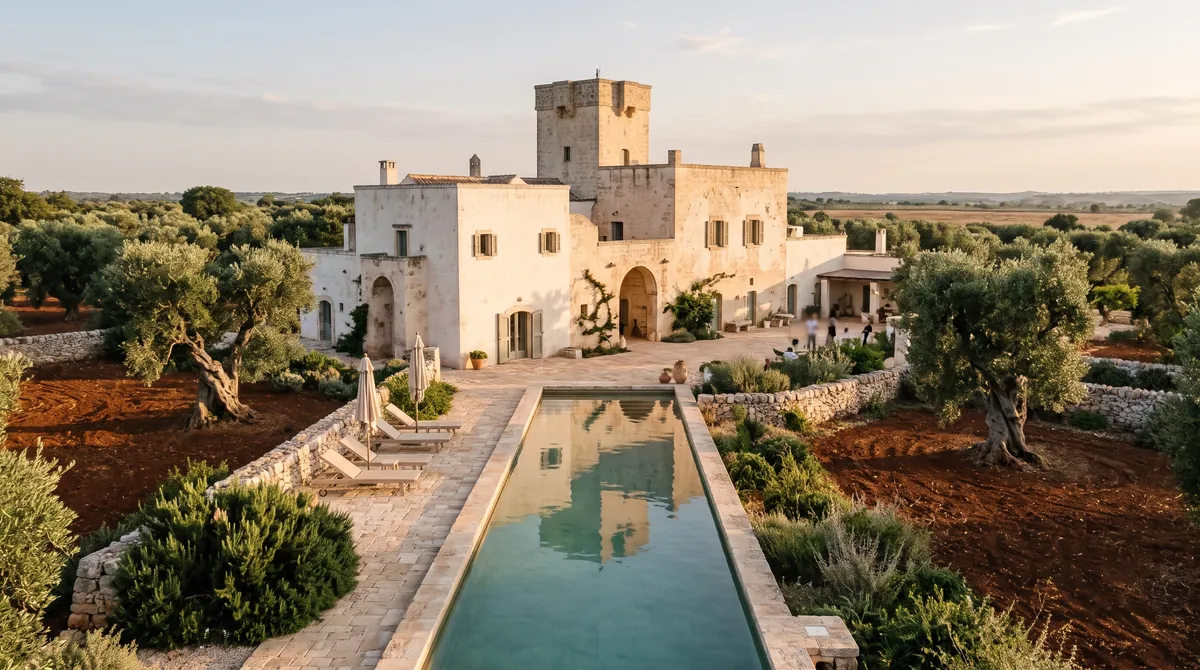
The gate is usually the first thing you notice: heavy, wooden, set into a white wall so thick that the shade inside feels like another season. Beyond it lies a courtyard of pale stone, a well or a cistern, an outside staircase climbing to the rooms, perhaps a squat tower with narrow slits for windows. Outside, the olive trees run in rows to the horizon, some so old that their trunks have twisted into knots and hollows. This is a masseria, the fortified farm of Puglia, and a few nights inside one are the best introduction to the heel of Italy.
Farms built like small fortresses
A masseria was never a villa. It was a working farm at the heart of a large estate, where the owner, the farm hands, the animals, the grain, the oil and the wine all lived behind one set of walls. Many were built from the sixteenth century onwards, partly as protection against raids from the sea, which explains the towers, the high blank walls and the single main entrance. Some have a small chapel by the gate, some an old oil mill cut into the rock below the house, and almost all have the deep courtyard around which farm life once turned.
That defensive past shapes how a masseria feels today. Walls that once kept raiders out now keep the summer heat at bay. Rooms stay cool through the afternoon, and vaulted stone ceilings give even a small bedroom a sense of height. Windows facing outwards tend to be few and small, so the best light falls into the courtyard rather than the rooms. Expect the charm of thick stone and silence rather than wide picture windows, and choose your room with that in mind: a room in the old house feels very different from one in a newer wing.
Walls that once kept raiders out now keep the summer heat at bay.
Among the ancient olive trees
Many masserie are now country hotels set among olive groves that have been tended for generations. Some trees are hundreds of years old, and the largest trunks are wider than you can reach around with both arms. The plain that runs from the hills below Ostuni towards the Adriatic is especially known for these giants, planted in long, irregular rows between dry stone walls. Walk out early, while the light is low and the red earth is still cool, and the shapes of the trunks look almost sculpted.
Olive oil is not decoration here. It is the reason many of these farms exist, and a good host will often pour a little of the estate’s own oil at breakfast or dinner, with bread and a few tomatoes. If the farm still produces oil, ask whether you can see the old mill or walk the groves where the harvest takes place. The answer is usually yes, and it tells you more about the place than any description on a screen.
Choosing your corner of Puglia
Puglia is long, and where you sleep decides how much of your holiday is spent in the car. For a first stay it helps to think of three areas, each with its own character. In the Valle d’Itria you will see the trulli, the round stone houses with conical roofs, scattered among vineyards and small fields. A masseria in any of the three areas makes an easy base for day trips of up to about an hour.
| Area | Character | Good for |
|---|---|---|
| Valle d’Itria | Green, rolling countryside between Alberobello, Locorotondo, Cisternino and Martina Franca, dotted with trulli | Village evenings, gentle drives, a first visit |
| Around Ostuni | The white town on its hill, ancient olive groves on the plain below and the Adriatic a short drive away | Olive trees, beaches and an evening stroll in town |
| Lecce and Salento | A baroque city of soft limestone and, further south, the coves and beaches of two seas | Architecture, swimming and longer stays |
Many travellers combine two areas on a week-long trip and move once in the middle.
Trulli, white towns and baroque stone
The trulli of Alberobello have been a UNESCO World Heritage Site since 1996, and the hillside quarters where they stand close together are a strange and lovely sight in the early morning, before the shops open. Around the town, the Valle d’Itria is softer and greener than you might expect in the south. Locorotondo looks out over the valley from its round old centre, Cisternino has quiet lanes and squares, and Martina Franca has elegant baroque streets of its own. Some country houses here have trulli converted into rooms, cool and domed, but often small, so ask about space and light.
Ostuni, the white town, climbs its hill above the olive plain, its lanes so brightly whitewashed that sunglasses are useful at midday. Lecce, further south, is a different world: a city of churches and palaces carved from soft local limestone that turns honey gold in the late afternoon. The façade of the Basilica di Santa Croce is the famous example, but the real pleasure lies in wandering the old centre as the stone warms in the evening light.
Two seas, two moods
Puglia has two coastlines. The Adriatic runs along its eastern side, and in the far south the Salento peninsula meets the Ionian Sea on its western shore. Broadly speaking, the Adriatic side of Salento is rockier, with cliffs and small coves of very clear water, while long stretches of the Ionian side are sandy and face the sunset. Locals often choose their beach by the wind of the day, because when one sea is choppy the other can be calm. A host who has lived here for years will know which way to send you.
In August the beaches of Salento are crowded and parking near the best coves fills early. Go in the morning, take water and shade, and leave the car only in marked spaces, since country lanes near the coast are narrow and easily blocked.
Long dinners in the courtyard
Masserie are usually out in the country, and many serve dinner, which is part of their appeal: nobody has to drive after a glass of wine. Expect orecchiette, the small ear-shaped pasta of the region, often with turnip tops or a simple tomato sauce, focaccia from the morning bake, vegetables from the garden and, with luck, burrata from Andria, a pouch of fresh cheese with a soft, creamy heart. The red wines are primitivo and negroamaro, deep and warm, and a chilled rosé made from negroamaro suits a summer evening well.
Ask when you book whether dinner is served every night or only on some evenings, and whether it needs to be reserved. Small places plan their cooking around the number of guests, and a table under the stars in the courtyard is worth arranging in advance.
Seasons, cars and old town centres
Summer in Puglia is hot, and August is the busiest month, when the coast fills with holidaymakers and the roads are slow. Spring and autumn are lovely: wild flowers among the olive trees in April and May, a warm sea and the grape harvest in September, quieter towns in October. You will need a car, as public transport rarely reaches the masserie. Many old town centres are ZTL zones (limited traffic zones), where cameras record cars entering without a permit and fines can follow by post long after you are home. Park outside the historic centre and walk in.
- Is the room in the old house, the tower or a newer wing? Each feels different.
- Is there air conditioning or at least a fan for July and August nights?
- Is dinner served, on which evenings, and does it need booking?
- How long is the drive to the nearest village and to the sea?
- Are there screens on the windows against mosquitoes on summer evenings?
Questions and answers
What exactly is a masseria?
A masseria is the traditional fortified farmhouse of Puglia: a complex of thick white walls, towers and courtyards at the heart of an agricultural estate. Many were built from the sixteenth century onwards, partly as protection against raids from the sea. Today many have been restored as country hotels, often still surrounded by their olive groves.
Do I need a car in Puglia?
Yes, for a masseria stay you do. Most lie outside the towns, and buses between villages are infrequent. Leave the car outside old town centres, many of which are limited traffic zones with camera controls.
Is August a good time to visit?
It is possible, but August is hot and the busiest month of the year, especially on the coast. Spring and autumn are calmer and still warm, and better for walking among the olive trees and exploring towns such as Lecce and Ostuni.
Can I sleep in a trullo?
In the Valle d’Itria some country houses and masserie have converted trulli into rooms. They are cool and full of atmosphere, but often small, with thick walls and little window space, so ask about size and light before you book.
Further reading in our network
- vinorinaWine regions of Europe
Wine regions of Europe, including the warm reds of southern Italy such as primitivo and negroamaro.
Our articles are general travel information written with care. Opening months, access and local rules change; check the details with your hotel before you travel.