
Agriturismo in Tuscany: a stay that follows the farm year
An agriturismo is a working farm first and a place to stay second. That is exactly its charm, from the grape harvest in autumn to the first green oil of November.
The tractor starts before breakfast. You hear it somewhere below the house, then the dogs, then a door, and by the time you carry your coffee out onto the terrace the mist is lifting off the vines and someone is already at work between the rows. Nobody is performing for you. On an agriturismo the farm goes about its day, and you are invited to share the edges of it: the table, the view, the oil on your bread, the wine from the cellar beneath your room.
A farm first, a place to stay second
Agriturismo is not simply a pretty word for a country hotel. It is farm accommodation regulated by Italian law: the farm must be a working agricultural business, and the hospitality is linked to that farm. In practice the people who welcome you also prune, harvest and press. Many serve their own wine, olive oil and produce, from honey and jam at breakfast to vegetables, cheese and meat at dinner.
The range is wide. At one end are simple rooms in a farmhouse, with a shared breakfast table and a family who are busy outside most of the day. At the other are restored stone farmhouses, the casali and poderi of the Tuscan countryside, with apartments, gardens and a pool looking over the hills. Both can be lovely, but they are different holidays. Read the description closely. A farm that talks about its harvests will feel different from one that talks about its sun loungers.
A farm that talks about its harvests will feel different from one that talks about its sun loungers.
Reading the farm calendar
Because the farm sets the rhythm, the month you choose changes the stay more than you might expect. The best seasons are May to June and September to October; August is hot and busy, with full roads and crowded hill towns.
| Season | On the farm | What it means for you |
|---|---|---|
| May to June | Vines in fresh leaf, wheat turning from green to gold, poppies along the field edges | Long light and mild days, the best time for walking |
| July to August | Heat, cut fields and work in the cool early hours | Hot afternoons by the pool, busy roads and towns |
| September to October | The grape harvest and the first wine in the cellar | Warm days, the smell of crushed grapes, a farm at full stretch |
| Late October to November | The olive harvest and the pressing of the new oil | Bright green, peppery oil on toasted bread, quieter roads |
| Winter | Pruning and repairs; some farms close to guests | Fewer places open, so check dates first |
Harvest dates shift with the weather each year, so ask your host when you book.
The grape harvest, the vendemmia, falls in September and October, and it is the season when a wine farm feels most alive. It is also the season when your hosts are tired and short of time, so be patient if breakfast is brisk. Some farms are happy for guests to watch the picking or the first work in the cellar. Ask, and do not be offended if the answer is no on a busy day.
From late October to November the olives are harvested, usually by combing the branches over nets spread beneath the trees, and taken to the mill as quickly as possible. The result is olio nuovo, the new oil: cloudy, vivid green and sharp enough to catch the back of your throat. Poured over toasted bread rubbed with garlic, it is one of the great simple tastes of Tuscany, and a reason many people come back in autumn.
Four landscapes to choose from
Tuscany is large, and a farm in the wrong corner can mean long hours in the car. Four areas suit a farm stay especially well.
- Val d’Orcia. A UNESCO World Heritage cultural landscape since 2004: smooth hills, cypress avenues and white roads around Pienza, Montalcino and San Quirico d’Orcia. Montalcino is the home of Brunello, and Pienza, a small town rebuilt in the Renaissance, is known for its sheep’s cheese.
- Montepulciano. A hill town of brick and stone on the edge of the Val d’Orcia, home of Vino Nobile, with old cellars running deep beneath its streets.
- Chianti. The wooded, vine-covered hills between Florence and Siena, close enough for a day in either city and full of small roads, villages and estates.
- Maremma. The wilder south west towards the coast: open pasture, Mediterranean scrub, long-horned cattle and beaches within reach for a swim.
White roads and the drive into town
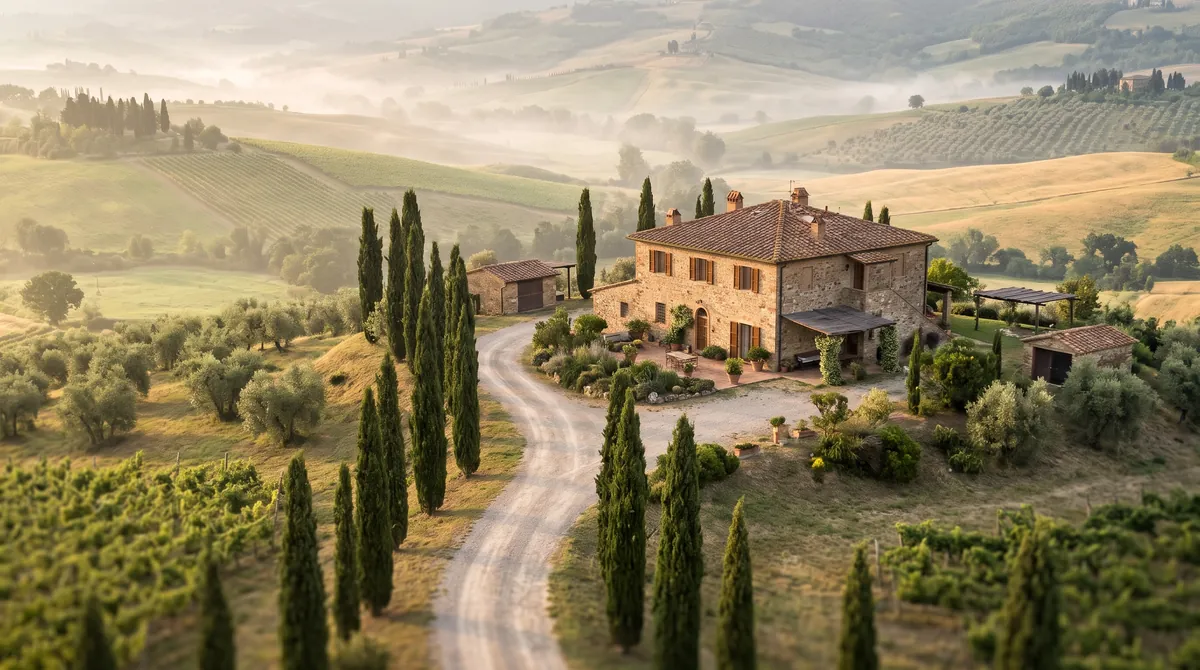
Many farms are reached by strade bianche, the white gravel roads that curve across the hills behind lines of cypresses. They are beautiful and slow. Drive the last stretch at walking pace, expect dust in summer and potholes after rain, and give way generously, since tractors and delivery vans use them too. A small hire car copes perfectly well; a low sports car does not.
A car is needed for almost any agriturismo, as buses rarely reach the farms. The difficulty comes in town. Most historic centres in Tuscany are ZTL zones (limited traffic zones), with cameras at the entrances recording every car that drives in without a permit. Fines can arrive months after your holiday, often through the hire company. The rule is simple: use the car parks outside the walls and walk in. In hill towns such as Montepulciano and Pienza, the walk up through the lanes is part of the pleasure.
Eating on the farm and nearby
Some agriturismi cook dinner for guests on certain evenings, sometimes at one long table, with dishes made from what the farm grows: pasta, beans, roast meat, vegetables from the garden and wine from the cellar. These evenings are often the most memorable of a stay, and they solve the question of the drive home. Ask when you book which nights dinner is served and whether it must be reserved.
If you eat out, plan a little. Many restaurants close one day a week, and the closing day differs from place to place, so check before you drive. In small villages there may be only one or two places to eat, and they fill quickly at weekends and in summer, so book dinner in the morning. In southern Tuscany look for pici, a thick hand-rolled pasta, often with a slow-cooked meat sauce. And never drink and drive on country roads after an evening of Brunello or Vino Nobile: book a taxi well in advance, or stay for dinner on the farm.
Questions before you book
- Ask whether the farm requires a minimum stay in summer; many do, and some let apartments by the week.
- Check whether breakfast is included or whether the apartment is self-catering.
- Ask about the pool season if a swim matters to you, since pools in the hills may not be open in early spring or late autumn.
- Ask how far the nearest village shop and restaurant are, in minutes by car rather than in kilometres.
- If you travel at harvest time, ask whether guests can watch the picking or the pressing.
Questions and answers
What is the difference between an agriturismo and a country hotel?
An agriturismo must be part of a working agricultural business, as Italian law requires, and its hospitality is linked to that farm. A country hotel has no such obligation. On an agriturismo you are more likely to eat the farm’s own produce and to see the farm at work.
Which area of Tuscany is best for a first farm stay?
The Val d’Orcia and the area around Montepulciano give you the classic landscape of cypresses and white roads, with famous wines close by. Chianti suits travellers who also want to see Florence or Siena. The Maremma is wilder and closer to the sea.
When can I taste the new olive oil?
The olive harvest usually runs from late October to November, and the olives go to the mill soon after picking. Farms that make their own oil often serve it fresh during these weeks, simply on toasted bread.
Are agriturismi open all year?
Many are, but some close in winter or open only part of the house. Check opening dates before you plan a visit between November and March, and ask whether dinner is still served out of season.
Further reading in our network
- vinorinaWine regions of Europe
Wine regions of Europe, with more on Brunello, Vino Nobile and the hills of Chianti.
Our articles are general travel information written with care. Opening months, access and local rules change; check the details with your hotel before you travel.