
Sleeping in a cortijo: life on Andalusia’s white farmsteads
Thick white walls, a courtyard full of jasmine and olive trees to the horizon. What a night in a converted Andalusian farmhouse really feels like, and how to choose the right one.
The track leaves the tarmac just after a bend, and for the next few kilometres the car moves at walking pace between olive trees. Dust rises behind you and settles on the leaves. Then the white walls appear, low and long, with a single gate and a palm that seems far too tall for the hill. Inside the courtyard it is suddenly quiet and noticeably cooler. Someone has just watered the pots of geraniums, the stones are still dark with it, and somewhere behind a wall a dog decides you are not worth barking at.
What a cortijo is, and what a hacienda is
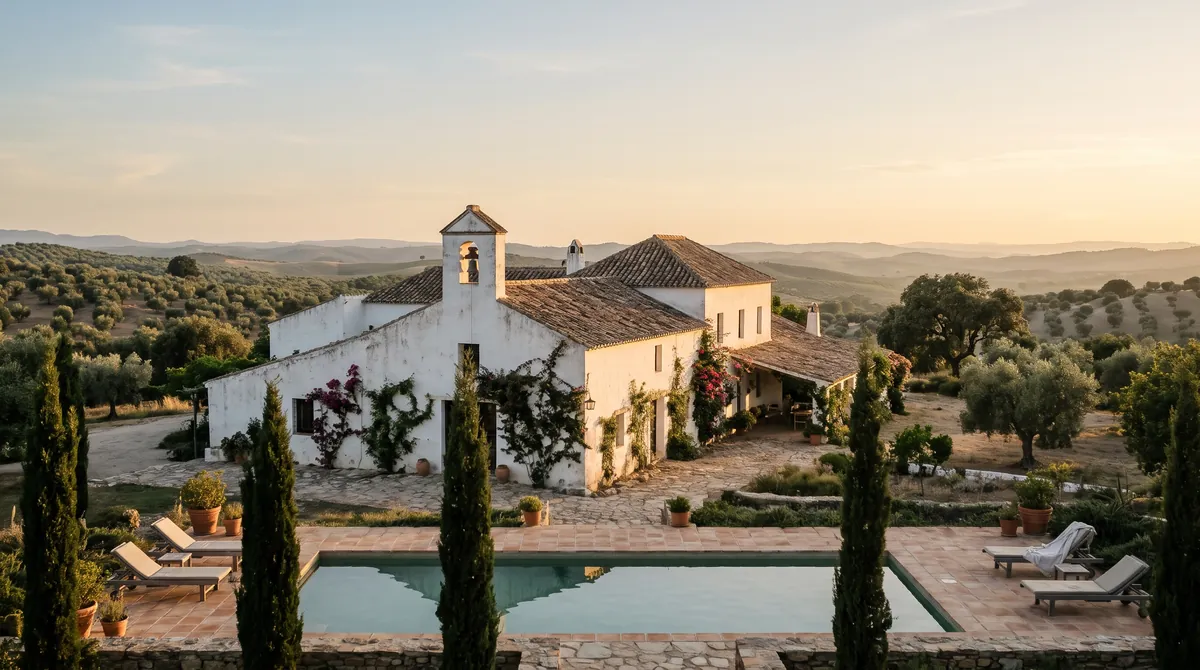
A cortijo is the traditional farmstead of the Andalusian countryside. It was built to work, not to impress: whitewashed walls to throw back the sun, a courtyard where carts were unloaded and animals watered, rooms with walls so thick that they stay cool long after midday. Around it lie the fields it was built for, olive groves, cereal land or woods of cork oak, depending on the province. A hacienda is usually a larger agricultural estate, typical of the countryside around Seville. Many have their own olive oil mill, a small chapel and a tower from which the owner could once look across his land, and they feel more like a hamlet than a house.
Many former working cortijos and haciendas have been carefully converted into small rural hotels. The best conversions keep the logic of the farm. Old stables become bedrooms with low beams, the oil mill turns into a dining room, the threshing floor becomes a terrace for watching the sunset. What changes is the sound: the mules and tractors have gone, and what remains is the wind in the olives and the bells of a distant flock.
Five landscapes, five kinds of quiet
Where you sleep shapes the trip more than the house itself. A cortijo in the open campiña, the rolling farmland of the Guadalquivir valley, gives you sky. One in the sierra gives you woods, cooler nights and walks from the door. Choose the landscape first, then the house.
| Landscape | What surrounds you | Best for |
|---|---|---|
| The campiña around Carmona and Écija | Rolling wheat and sunflower fields, olive groves, wide horizons | Day trips to Seville and Córdoba, huge skies at sunset |
| Sierra de Aracena, province of Huelva | Chestnut and cork oak woods, small white villages, pigs grazing under the oaks | Walking, cool summer nights, the cured ham of Jabugo |
| Sierra de Grazalema | Limestone peaks, green valleys, dense woods | Hiking and an easy link to the white villages |
| The Axarquía, east of Málaga | Vineyards and avocado terraces on steep slopes, often with the sea in view | Combining countryside with the coast |
| The olive country of Jaén | Olive trees in rows to the horizon, the Renaissance towns of Úbeda and Baeza within reach | The olive harvest and quiet off-season stays |
Rural roads take longer than they look on a map. Allow extra time for the final stretch of track.
In the Sierra de Aracena the cork oaks stand in open pasture called dehesa, where black Iberian pigs root for acorns in autumn. The famous cured ham from Jabugo comes from these hills, and a few thin slices at breakfast, with toasted bread and olive oil, tell you more about the place than any guidebook. In the campiña, by contrast, the land is open and golden in early summer, and Écija has long been nicknamed the frying pan of Andalusia.
The shape of a day
Life in a cortijo follows the heat and the light. In summer you walk or swim early, before the sun clears the hill, and retreat indoors after lunch. The siesta is not laziness here but common sense: shutters closed, a ceiling fan turning, the thick walls doing their old work. Late afternoon brings the countryside back to life, with swallows over the courtyard and the smell of warm earth as someone waters the garden.
Dinner is often served at the house, sometimes at one long table, sometimes in the courtyard under a vine. That is more than charm. In many places it is the only sensible option, because the nearest village restaurant is a drive away along a dark track. After dinner, walk a few steps beyond the lights. Far from towns, the night sky is deep and crowded with stars, and on a clear, moonless night you can follow the Milky Way from one horizon to the other while crickets fill the silence.
The siesta is not laziness here but common sense: shutters closed, a ceiling fan turning, the thick walls doing their old work.
What to expect, honestly
A rural stay asks for a little adjustment, and knowing the realities in advance saves disappointment.
- A car is almost always needed. Public transport rarely reaches farm country, and a taxi from the nearest town may not know the way.
- The access road may be unpaved. Tracks of a few kilometres are common. They are usually fine in a normal car if you drive slowly, but heavy rain can leave mud and potholes.
- Distances are real. A forgotten toothbrush can mean a long round trip to the village, so pack what you need and shop before you arrive.
- Mobile signal and wifi can be patchy in valleys and behind hills. Many guests discover that this is rather the point.
- Country life comes with the setting. Geckos on the walls, a rooster at dawn and the odd insect in summer are part of it.
- Quiet is the rule. Sound carries far in open country, and music on a terrace at midnight reaches every bedroom.
Details worth looking for
The pleasures of a good cortijo are physical and simple. Terracotta floors are cool underfoot in summer and hold the warmth of a fire in winter. A patio with bougainvillea and jasmine smells strongest in the evening, when the air begins to cool. A pool among olive trees, where you swim with a view of silver leaves and hills, is one of the quiet joys of a summer stay. In winter, look for a fireplace: inland nights from December to February can be properly cold, and a stone house without good heating feels colder than the thermometer suggests.
Some houses still press their own olive oil or keep a kitchen garden, and the table shows it: tomatoes still warm from the plant, oil so green it tastes of cut grass, oranges picked the same morning. If the house has kept its old mill, press or barn, ask to see it. Hosts are usually glad to show how the place once worked, and the story of the farm often explains the shape of your room.
Questions to ask before you book
Photographs show the pool and the bedroom. They rarely show the track or the boiler. A short message to the host before booking settles the things that matter most.
- What is the access road like? Ask how long the unpaved stretch is, whether a normal car manages it and what happens after heavy rain.
- How far is the nearest village? Find out whether there is a shop, a bakery and somewhere to eat within a short drive, and whether you can walk there.
- Which meals are served? Ask whether dinner is offered every night or only on certain days, and whether it must be ordered in advance.
- How is the house heated in winter? A fireplace is lovely, but for stays between November and March ask about heating in the bedrooms themselves.
- When is the pool open? Rural pools are often seasonal, so check if you travel in spring or autumn.
When to go
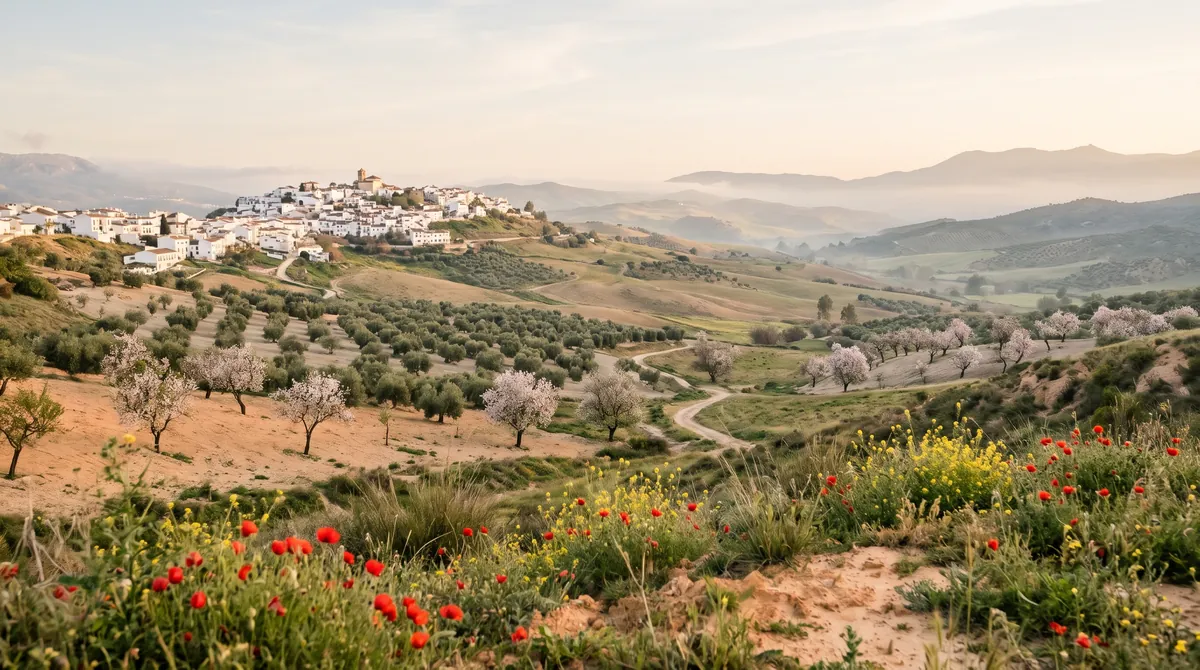
Spring is the easiest season for a first cortijo stay: green fields, wildflowers along the tracks, warm days and fresh nights. Autumn is a close second, especially in the Sierra de Aracena, where the chestnut woods turn gold and the air smells of woodsmoke. Summer works if you accept the rhythm of the heat and choose a house with a pool or a sierra setting. Winter is the season of log fires and long lunches in the sun, and the olive harvest gives the countryside a busy, cheerful life of its own.
Questions and answers
What is the difference between a cortijo and a hacienda?
A cortijo is the traditional farmstead of the Andalusian countryside, built around a courtyard with thick whitewashed walls. A hacienda is usually a larger agricultural estate, typical of the area around Seville, often with its own olive oil mill, chapel and tower. Both are now found as small rural hotels.
Do I need a car for a cortijo stay?
Almost always, yes. Most cortijos lie outside villages, often at the end of an unpaved track, and public transport rarely reaches them. A car also gives you the freedom to explore the villages and landscapes around the house.
Is a cortijo comfortable in winter?
It can be wonderfully cosy, but ask before you book. Inland nights are cold from about December to February, and thick stone walls hold the chill as well as the cool. Look for a fireplace and proper heating in the bedrooms.
Can I eat at the house?
Often, yes. Many rural hotels serve dinner, sometimes at a shared table and usually with local produce. Because the nearest restaurant may be a drive away, ask in advance which nights dinner is offered and whether you need to book it.
Further reading in our network
- andaluisTravel and sights in Andalusia
Travel and sights across Andalusia, from Seville and Granada to Ronda and the white villages.
Our articles are general travel information written with care. Opening months, access and local rules change; check the details with your hotel before you travel.