
Granada: sleeping in a carmen below the Alhambra
A walled garden, a fountain, a terrace under a vine and, across the valley, the red walls of the Alhambra. How to stay in one of the Albaicín’s carmens, and how to plan your days around it.
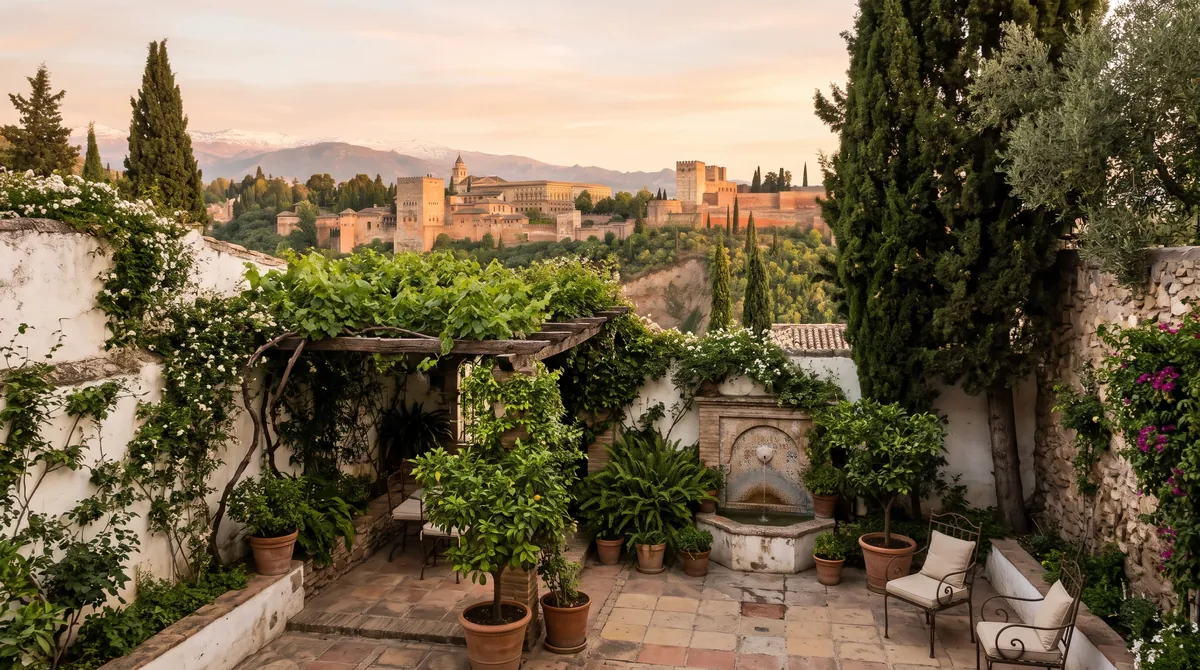
The taxi stops where the lane becomes too narrow, and you walk the last 100 metres over cobbles laid in patterns of black and white pebbles. A door in a long white wall opens onto a garden you could never have guessed from outside: a terrace of lemon trees, a vine on a pergola, water trickling along a stone channel. Then you reach the edge of the terrace and stop. Across the valley the Alhambra sits on its hill, its walls turning red in the late sun, and behind it, in winter, lies the snow of the Sierra Nevada.
What a carmen is
A carmen is the traditional house of Granada’s Albaicín quarter: a whitewashed house with a walled garden, laid out in terraces down the hillside, planted with fruit trees and vines and cooled by fountains. The name is usually traced to an Arabic word for vineyard, and the idea is old: a private world of shade and water behind blank walls, turned towards the view rather than the street. Many carmens look straight across the Darro valley to the Alhambra.
Staying in one changes the way you see the city. Instead of a corridor and a lift, you have steps between garden levels, a breakfast table under a fig tree, roses, myrtle hedges and perhaps a small pool fed by a channel. Rooms are usually few and individual, and the garden is shared, much as it would be in a family home. At night the only light may be the floodlit Alhambra across the valley, and the only sound the water.
At night the only light may be the floodlit Alhambra across the valley, and the only sound the water.
The Alhambra, the Albaicín and your ticket
The Alhambra and the Generalife became a UNESCO World Heritage Site in 1984, and the listing was extended to the Albaicín in 1994. That second date matters if you stay up here: the quarter you sleep in is protected as part of the same story as the palace opposite, and its lanes, cisterns and walled gardens still follow the pattern of the Moorish town.
Tickets for the Nasrid Palaces are timed, and they should be booked well in advance, especially for spring, autumn and holiday weekends. You enter the palaces at the time printed on your ticket, not when it suits you, so plan the rest of the visit around that slot. Tickets are usually issued in your name, so carry the passport or identity card you booked with.
- Book the palace first. Secure your Nasrid Palaces slot before you fix the other days of the trip.
- Choose a morning slot in summer, when the gardens of the Generalife are still cool and the light is soft.
- Ride up, walk down. The climb to the Alhambra is long and steep, so many visitors take a taxi or a small bus up and walk back down through the woods.
- Bring water and a hat. The site is large and much of it lies in the open sun.
Evenings on the hill
The Mirador de San Nicolás is the classic viewpoint at sunset, a terrace beside a church where the whole length of the Alhambra lies opposite, with the Sierra Nevada behind. It is popular, so come early, or look for one of the smaller viewpoints in the lanes nearby, where the view is almost the same and the crowd far smaller. Many carmens have their own version of this view, which is the best reason of all to be home by sunset.
Above the Albaicín, Sacromonte climbs the hillside with its cave houses dug into the soft rock, the home of a long flamenco tradition. An evening of flamenco in a cave, close enough to hear the dancer’s breath and the snap of the heels on the floor, stays with you long after the trip.
Down in the city, Granada keeps a custom that delights every visitor: in many bars a small tapa arrives free with each drink. Order a glass of wine or a small beer, a plate follows, and in some bars it changes with every round. Two or three bars make an easy, cheerful dinner, and the walk home up the hill settles it.
Travel light: the practical side
The charm of the Albaicín is also its challenge. The quarter is steep, the lanes are cobbled and often stepped, and cars cannot reach many houses. Vehicle access is restricted in much of the old quarter, so never try to drive to the door unless your host tells you exactly how.
- Pack one small suitcase or a soft bag, because wheels and cobbles are not friends.
- Ask your host for the nearest point a taxi can reach, and whether someone can meet you there.
- Use the small buses that climb the hill for trips between the Albaicín and the city centre.
- Wear shoes with grip, as the polished pebbles are slippery after rain.
- If you arrive by car, leave it in a public car park at the foot of the hill for the length of your stay.
Water, steam and snow
Arab baths, the hammam, are part of Granada’s heritage. An old Moorish bath survives on the Carrera del Darro below the Albaicín, with star-shaped skylights in its vaulted ceiling, and modern baths in the old town keep the custom alive with warm pools, steam and mint tea. After a day on the hills, an hour moving between warm and hot water is the perfect remedy for tired legs.
The Sierra Nevada rises behind the city, with snow in winter, and skiing and the city can be combined in one trip: a morning on the slopes, an evening on a carmen terrace looking back at the white peaks. Winter nights in Granada are cold, so look for a house with good heating and heavy blankets. In summer the city is hot, but a shaded garden with running water stays far more pleasant than a room on a busy street.
When to come
Spring and autumn are the best seasons. In April and May the carmen gardens are full of roses and the hills are green, and in October the light is soft and the evenings warm enough for dinner outside. Summer is hot, so plan the Alhambra early in the day and the Albaicín after sunset. Winter brings clear skies, snow on the mountains, cold nights and far fewer visitors in the lanes. Two or three nights let you see the palace without rushing and still have an evening simply sitting in the garden.
Questions and answers
What is a carmen in Granada?
A carmen is the traditional house of the Albaicín quarter: a whitewashed house with a walled garden on terraces, fruit trees, vines, fountains and often a view of the Alhambra. Several have been converted into small hotels and guest houses.
How far ahead should I book Alhambra tickets?
As early as you can, especially for spring, autumn and holidays. Tickets for the Nasrid Palaces are timed and can sell out well in advance, so book them before you fix the rest of your plans.
Can I drive to a carmen in the Albaicín?
Usually not to the door. The lanes are steep, narrow and cobbled, vehicle access is restricted and many houses cannot be reached by car. Taxis and small buses climb the hill, and the rest is a short walk.
Is Granada worth visiting in winter?
Yes, if you like crisp, clear days. The city is quieter, the Sierra Nevada is covered in snow and skiing can be combined with sightseeing. Nights are cold, so choose a well heated room.
Further reading in our network
- andaluisTravel and sights in Andalusia
Travel and sights in Andalusia, including Granada, Seville, Ronda and the white villages.
Our articles are general travel information written with care. Opening months, access and local rules change; check the details with your hotel before you travel.