
Seville’s casas palacio: courtyards, azulejos and orange trees
Behind a plain front door, a patio with a fountain, marble columns and tiles in every shade of blue and ochre. How to stay well in one of Seville’s old noble townhouses.
From the street you see almost nothing: a heavy wooden door, a wrought iron gate behind it, a glimpse of light. Then the gate opens and the city falls away. There is a patio paved in marble, a fountain murmuring in the middle, slender columns holding up a gallery, and a wall of glazed tiles in deep blue, green and honey yellow. An orange tree throws shade across one corner. The air smells faintly of damp stone and jasmine, and the traffic of Seville seems to belong to another town.
A house turned inwards
The casa palacio is the noble townhouse of old Seville, and it is built around one idea: life faces the patio, not the street. You enter through the zaguán, a tiled hallway, and look through a decorative iron gate, the cancela, into the courtyard. The rooms open onto arcades around the patio, often on two floors, with marble columns below and a gallery above. Plants, a central fountain and walls of glazed tiles, the azulejos, make the patio the coolest and greenest place in the house.
This turned-in plan is a lesson in living with heat. The street side stays quiet and shady, small windows and thick walls keep the sun out, and the patio collects the cool night air and releases it slowly through the day. In summer, canvas awnings were traditionally drawn across the patio for shade, and families often lived on the ground floor in the hottest months and moved upstairs for winter. When you stay in a casa palacio converted into a small hotel, you are living inside that old logic.
Life faces the patio, not the street.
Mudéjar craft and the Alcázar
Much of what makes these houses beautiful comes from the Mudéjar tradition: Christian architecture that kept the Islamic craft traditions of the south, from carved plasterwork and coffered wooden ceilings to geometric tilework. The grandest example is the Real Alcázar, still a royal residence, whose patios and gardens set the pattern for courtyards all over the city. Together with the Cathedral and the Archivo de Indias, the Alcázar has been a UNESCO World Heritage Site since 1987.
Visit the Alcázar early, then look again at the tiles in your own patio. Older azulejos often vary slightly in colour from one tile to the next, a sign of hand glazing. Across the river in Triana, the city’s ceramics tradition is still alive, and a walk past its workshops and tiled shopfronts shows where so much of Seville’s colour comes from.
Choosing your neighbourhood
Most casas palacio lie within the old town or just across the river, and each quarter has its own character. All of them are walkable, which is fortunate, because a car is more burden than help in the old centre.
| Neighbourhood | Character | Good to know |
|---|---|---|
| Barrio de Santa Cruz | Narrow lanes of the old Jewish quarter, small squares with orange trees | Next to the Alcázar and the Cathedral; busy by day, hushed late at night |
| Arenal | Between the Cathedral and the river, near the bullring | Easy walks along the Guadalquivir; lively bars in the evening |
| Alfalfa | A web of streets and little squares in the heart of the old town | Very central, with a local feel and plenty of tapas bars |
| Triana | Across the river, with its ceramics tradition and riverside views | A short walk over the bridge; more neighbourhood than museum |
Which room to choose
In a casa palacio the choice of room matters more than in almost any other hotel. A room on the patio is the classic choice: quieter, cooler and full of the sound of water, though its windows may face the gallery rather than the sky, so mornings can be dim. A room on the street side gets more daylight and sometimes a balcony, but also the voices of late diners walking home. Upstairs rooms catch more breeze in spring and autumn, while ground-floor rooms stay coolest in high summer.
- Ask where the room faces. Patio, street or garden makes a real difference to light and noise.
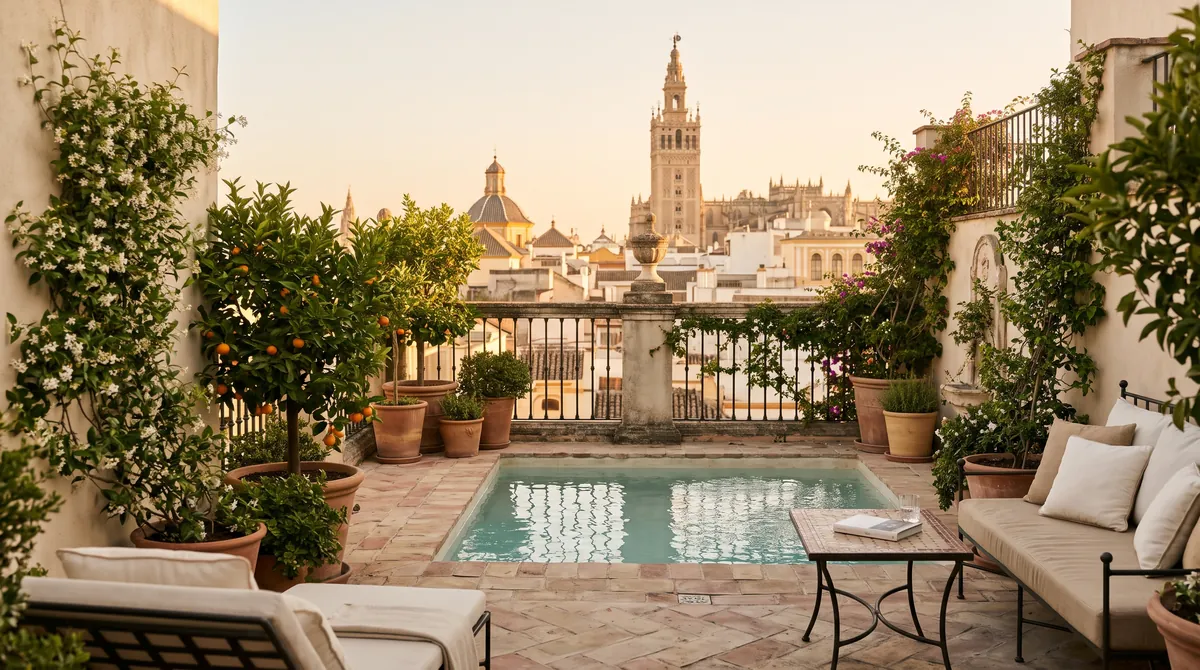
- Ask about the roof. Many old houses have an azotea, a flat roof turned into a terrace, with views of the Giralda and the rooftops.
- Consider the stairs. Historic buildings do not always have lifts, and steps can be steep and uneven.
- Expect thick walls, not soundproofing. Voices carry around a patio at night, so a room off a quiet corner of the gallery is worth requesting.
- Ask about Holy Week. If you travel in spring, find out whether processions pass the street and until what time.
Living to Seville’s clock
Seville runs on a later clock than northern Europe, and a casa palacio is the perfect place to adopt it. Breakfast is unhurried, sightseeing fills the cooler morning, lunch comes late, often after two in the afternoon, and the hottest hours belong to the siesta behind closed shutters. The city fills again in the evening. Dinner rarely starts before nine in the evening, and on warm nights the squares stay busy until well after midnight.
The roof terrace comes into its own at the end of the afternoon. As the heat breaks, the stone of the Giralda turns gold and then pink, swifts scream over the rooftops and bells ring across the old town. Take a glass of chilled fino up with you, and the roof begins to feel like the best room in the house.
Orange blossom, Holy Week and the heat
Timing changes these houses completely. In March the city’s orange trees flower, and the scent of azahar drifts into patios and through open windows, strongest in the evening. Holy Week, Semana Santa, fills the spring streets with processions, as brotherhoods carry their floats through the old town by day and deep into the night. It is moving to witness, but if a route passes your door you may hear drums and bands in the small hours, so ask before you book. The April Fair, the Feria de Abril, usually follows about two weeks after Easter, and the city is full.
July and August are extremely hot. Inland temperatures often pass 40 °C, and even the coolest patio becomes a refuge rather than a place to sit. The best months are roughly March to May and October to November, when you can take breakfast in the patio, dinner on the roof and walk the old town at any hour.
Questions and answers
What is a casa palacio?
A casa palacio is a noble townhouse built around a central patio with a fountain, arcades, marble columns and glazed tiles. The rooms open onto the patio, while the street side stays quiet and shady. Several in Seville’s old town are now small hotels.
Which area of Seville is best for a first stay?
The Barrio de Santa Cruz puts you next to the Alcázar and the Cathedral, Alfalfa feels more local, and Triana offers a neighbourhood mood across the river. All three are within walking distance of the main sights.
When is the best time to visit Seville?
Roughly March to May and October to November. March brings orange blossom, and spring brings Holy Week and the April Fair, both very busy. July and August are extremely hot, often above 40 °C.
Is Seville noisy during Holy Week?
Parts of the old town can be, because processions pass through narrow streets by day and late into the night. A room on the patio is quieter, and it is worth asking the hotel whether a route passes the house.
Further reading in our network
- andaluisTravel and sights in Andalusia
Travel and sights in Andalusia, with Seville, Granada, Ronda and the white villages.
Our articles are general travel information written with care. Opening months, access and local rules change; check the details with your hotel before you travel.