
Harbours and quiet coves: Mallorca by the sea
From the round harbour of Port de Sóller to the salt flats behind Es Trenc, Mallorca’s coast changes character every few kilometres. How to choose your stretch of sea, and the hotel to go with it.
The best swim of the day is often the first. At half past seven the water in a small cove is so still that you can see your shadow on the sand three metres below, and the only sound is a fishing boat puttering out past the rocks. By noon the same cove may be lined with towels. Mallorca’s coast rewards those who learn its rhythms: which stretch suits which mood, which hour belongs to whom, and which hotel lets you walk to the water before breakfast.
One island, several coasts
Mallorca’s coast changes completely as you travel round it. In the north west, the Tramuntana mountains drop into the sea in cliffs, with few beaches and dramatic harbours. The north opens into long bays with shallow water. The east and south are a coastline of rocky coves, the calas, cut into low limestone cliffs, with pines growing almost to the edge and water of an improbable turquoise. Choose your coast first and your hotel second, and you will spend far less time in the car.
| Coast | Character | Best for |
|---|---|---|
| North west | Cliffs, mountain views and the round harbour of Port de Sóller | Walkers, sunsets and boat trips along the cliffs |
| North | The wide, shallow bays of Pollença and Alcúdia, and the Formentor peninsula | Families, easy swimming and long walks on the sand |
| East | Small coves, fishing harbours and the Mondragó Natural Park | Snorkelling, quiet swims and small hotels |
| South | The long natural beach of Es Trenc, with dunes and salt flats | Long beach days and wide open views |
Port de Sóller and Formentor
Port de Sóller is a round natural harbour, almost enclosed by mountains, with a promenade that follows the curve of the bay. It is a place for slow evenings: a walk along the water, fishing boats at their moorings, lights coming on one by one around the bay. The headlands at the harbour mouth look out over the open sea, which makes them a fine place to watch the sun go down, and boats leave from the harbour for trips along the cliffs of the Tramuntana.
Further north, the Formentor peninsula runs out into the sea as a ridge of cliffs, with viewpoints along the way and a lighthouse at its tip. The road is narrow and winding, and access by car can be restricted in high summer, so check before you set off. Go early in the morning or in the hour before sunset, when the light is soft, the cliffs glow and the road is calmer.
The bays of the north
The bays of Pollença and Alcúdia offer the gentlest swimming on the island. The water stays shallow a long way out, warms quickly in early summer and suits children and anyone who prefers to walk into the sea rather than jump. Both bays have long seafront promenades for an evening stroll, and the old town of Pollença, a few kilometres inland, and the walled old town of Alcúdia give you somewhere to wander when the beach day is over. In summer, boats cross from Port de Pollença to the beach at Formentor, a pleasant way to avoid the road.
Calas and fishing harbours of the east
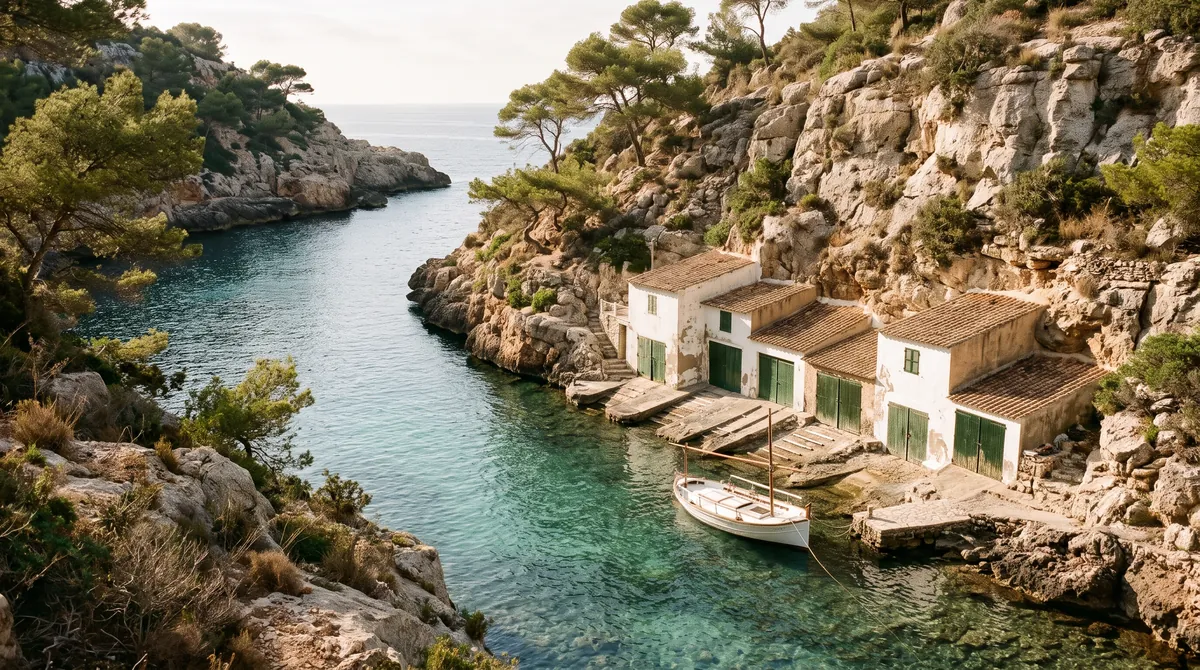
The east coast is where you find the small coves of Mallorca’s postcards. Cala Figuera is a fishing harbour in a narrow, branching inlet, with boathouses at the water’s edge and traditional wooden boats, the llaüts, rocking at their moorings. Come early to see the fishermen at work, or late in the afternoon when the water turns green and gold. Nearby, the Mondragó Natural Park protects coves of pale sand backed by pine woods, with footpaths linking them. Cala Llombards, a little further along the coast, is a small cove between rocky walls, with boathouses and pines above the water.
Es Trenc and the salt flats
In the south, Es Trenc is something rare on a busy Mediterranean island: a long natural beach with dunes, largely free of buildings. Behind it lie salt flats where salt is still harvested, and in the shallow pools you may spot wading birds. The water is shallow and clear, the sand pale, and on a calm day the colours look almost tropical. Bring shade and plenty of water, because there is little natural shelter and the sun is strong, and keep to the marked paths through the dunes.
Seagrass and clear water
The reason Mallorca’s water is so clear lies beneath the surface. Meadows of Posidonia seagrass, a plant found only in the Mediterranean, cover large areas of the sea floor, where they filter the water, shelter young fish and protect beaches from erosion. They are protected, and anchoring on them is forbidden. In winter you may see banks of their dead leaves washed up on some beaches: they look untidy, but they guard the sand against storms and should be left where they are.
- Swim inside the buoyed areas where they exist, and watch for boats near harbour mouths.
- If you rent a boat, drop anchor only on sand, never on seagrass, or use a mooring buoy where one is provided.
- Take everything home with you, cigarette ends included, and stay on the paths across the dunes.
- Check the flags and the wind: on some days the swell makes even sheltered coves unsafe.
Choosing a seaside hotel
The right seaside hotel is less about luxury than about position. Walking distance to the water is the single most useful feature: it lets you swim before breakfast and again after the crowds have gone, without a car or a parking space. A room with a sea view changes a stay completely, so ask exactly which rooms face the water and which look over the garden or the street. If you want quiet coves, come outside July and August.
The right seaside hotel is less about luxury than about position.
The swimming season runs roughly from June to October, and spring and autumn are calmer on the coast. Some of the loveliest coves have no road at all: a boat trip from the nearest harbour is the way to reach them, and arriving from the sea is half the pleasure. Ask your hotel which boats leave nearby and whether they need booking.
Questions and answers
Which part of Mallorca has the prettiest coves?
The east and south have the classic small calas, such as those of the Mondragó Natural Park and Cala Llombards. The north has long shallow bays, while the north west has cliffs and harbours rather than beaches.
Can I drive to Formentor?
Yes, but the road is narrow and winding, and access by car can be restricted in high summer. Check before you go, set off early, or take a boat across the bay from Port de Pollença in the season.
When is the sea warm enough to swim?
The swimming season runs roughly from June to October. The water is usually warmest late in summer and stays pleasant into autumn, when the beaches are calmer.
Why are there brown leaves on some beaches?
They are dead leaves of Posidonia seagrass, which protect the sand from storms and erosion. They are part of a healthy coast and should be left where they are.
Further reading in our network
- island mallorcaThe island atlas
The island atlas of Mallorca, with beaches, coves and coastal walks all around the island.
Our articles are general travel information written with care. Opening months, access and local rules change; check the details with your hotel before you travel.