
Palma’s old town: sleeping in a noble townhouse
Behind heavy wooden doors, Palma’s old town keeps courtyards, stone staircases and roof terraces. What to expect from a hotel in a noble casal, which quarter suits you and how to arrive calmly.
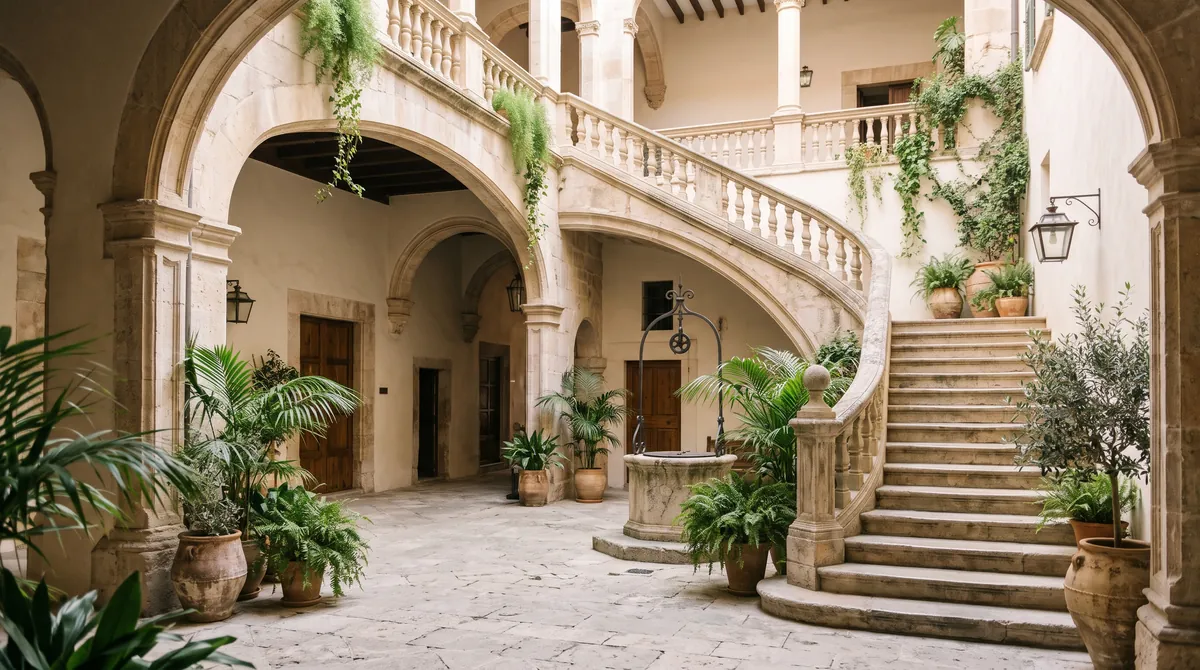
Push open the heavy door from the lane and the noise of the city drops away. You stand in a stone courtyard, cooler than the street, with an old well in one corner, a broad staircase rising beneath an arch and a square of sky above. Somewhere water is running. This is a pati, the heart of a Palma casal, and for a few nights it can be the heart of your stay too: a private, quiet space in the middle of a busy and beautiful old town.
Inside a casal
The casals are the noble townhouses of Palma’s old town, built around a courtyard with a stone staircase, arches and wells. From the lane they can look severe, with plain walls, tall windows and closed shutters; the beauty is kept inside. The staircase usually leads to the main floor, where the family once received guests in rooms with high ceilings and wooden beams. When such a house becomes a hotel, the best rooms often keep those proportions: a ceiling far above your head, tall windows set deep in the wall, old tiles cool underfoot.
History brings quirks too. Floors may slope gently, doors creak, and thick walls can weaken the phone signal in some rooms. Lifts are often small, squeezed into a former light well, and a few rooms may only be reached by stairs. None of this is a flaw, but it helps to know before you arrive, especially with heavy luggage or if stairs are difficult for you.
In late spring some private courtyards traditionally open to visitors, a rare chance to look behind doors that stay closed for the rest of the year. If your dates allow, it is one of the loveliest times to be in the city.
Which quarter suits you
The old town is compact enough to explore entirely on foot, but each quarter has its own mood, and the right one depends on how you like to spend your evenings.
| Quarter | Character | Best for |
|---|---|---|
| Around La Seu and the Almudaina | Narrow lanes, palaces and churches, quieter at night | A first visit and early morning walks |
| Sa Llotja | Lanes near the old exchange, busy with bars and restaurants | Evenings out on foot |
| Passeig del Born | An elegant avenue with shops and cafés | A central base with easy taxis |
| Santa Catalina | Lively streets around its market | Food lovers and late dinners |
| Es Jonquet | The old fishermen’s quarter with windmills above the water | Sunsets and a village feel |
Santa Catalina and Es Jonquet lie just west of the old town, a short walk from the centre.
La Seu, the walls and the castle
Whichever quarter you choose, the cathedral will be your compass. La Seu, the great Gothic cathedral, stands above the old sea wall, golden stone against the blue of the bay, and its interior was later reworked in part by Antoni Gaudí. Go in the morning, when sunlight pours through the rose window and scatters coloured light across the stone. Then walk along the old walls with the sea on one side and the lanes on the other, or climb past the Almudaina palace into the narrow streets behind it.
Above the city, Bellver Castle stands on a wooded hill, a rare round Gothic castle with a circular courtyard and views over the bay and the rooftops. Walk up through the pines in the late afternoon and come back down for dinner: it is the best way to understand how the old town sits between the sea and the hills.
Roof terraces and quiet rooms
Many townhouse hotels have turned their flat roofs into terraces, often with a plunge pool, loungers and a view of bell towers and the pinnacles of the cathedral. On a summer evening this is the place to be, as swallows race over the rooftops and the stone gives back the warmth of the day. Ask whether the terrace is open to all guests or kept for certain rooms, and until when it stays open in the evening.
For sleep, the golden rule is simple: rooms facing the courtyard are quieter. Street-facing rooms often have the prettier windows and balconies, but the old town is lively late into the night in summer, and the early morning brings delivery vans, street cleaning and church bells. If you sleep lightly, a courtyard room or one high up is worth more than a balcony.
For sleep, the golden rule is simple: rooms facing the courtyard are quieter.
Arriving without stress
Much of the old town is pedestrian or restricted for cars, and the lanes were laid out long before anyone imagined a hire car. Driving in on instinct is the classic mistake, followed by a long search for somewhere to stop. Before you travel, ask the hotel how arrival works, and keep its answer on your phone. Many guests leave the car outside the centre for the city part of a trip and collect it only when they head for the mountains or the countryside.
- Where exactly can a taxi drop me, and how far is the walk from there?
- Can access be arranged for a car, and where is the nearest public car park?
- Does my room face the courtyard or the street?
- Is there a lift, and does it reach every floor?
- When is the roof terrace open, and is the plunge pool heated outside summer?
Breakfast, markets and the rhythm of the day
A Palma morning begins with an ensaïmada, the spiral pastry dusted with icing sugar, and a coffee at a counter beside people on their way to work. Then walk: almost everything worth seeing in the old town lies within a short stroll. The market in Santa Catalina is liveliest in the morning, with fish, fruit and small counters serving food, while the lanes of Sa Llotja and the Passeig del Born fill up towards evening. Lunch is late by northern European habits and dinner later still, so plan a pause in your cool room during the hottest hours.
A city for every season
Palma works well all year as a city break. Spring and autumn bring warm days for long walks, summer is hot and lively with the roof terraces at their best, and winter is quieter, with mild days, shorter queues at the cathedral and tables easy to find. Two or three nights are enough for the old town; add a day for the castle, the market and the waterfront, or pair the city with a stay in the mountains or on a country estate.
Questions and answers
Is it worth staying in Palma’s old town rather than by the sea?
For a city break, yes. You can walk to the cathedral, the markets and the restaurants, and a townhouse hotel gives you a quiet courtyard in the middle of it all. The beaches are a short drive or bus ride away.
Can I drive to my hotel in the old town?
Often only partly. Much of the old town is pedestrian or restricted for cars, so ask the hotel how arrival works, whether access can be arranged and where the nearest car park is.
When do Palma’s private courtyards open to visitors?
Traditionally some private courtyards open in late spring. Ask your hotel or the tourist office for the current dates when you plan your trip.
Further reading in our network
- island mallorcaThe island atlas
The island atlas of Mallorca, with villages, beaches and walks beyond the city.
- trevisitShort trips and city breaks
Short trips and city breaks, with more ideas for a few days in a historic city.
Our articles are general travel information written with care. Opening months, access and local rules change; check the details with your hotel before you travel.