
The Alentejo: cork oaks, white towns and an endless sky
South of the Tagus, Portugal slows right down. How to choose a country estate in the Alentejo, live with the summer heat, read the cork oaks and find the darkest skies in the south.
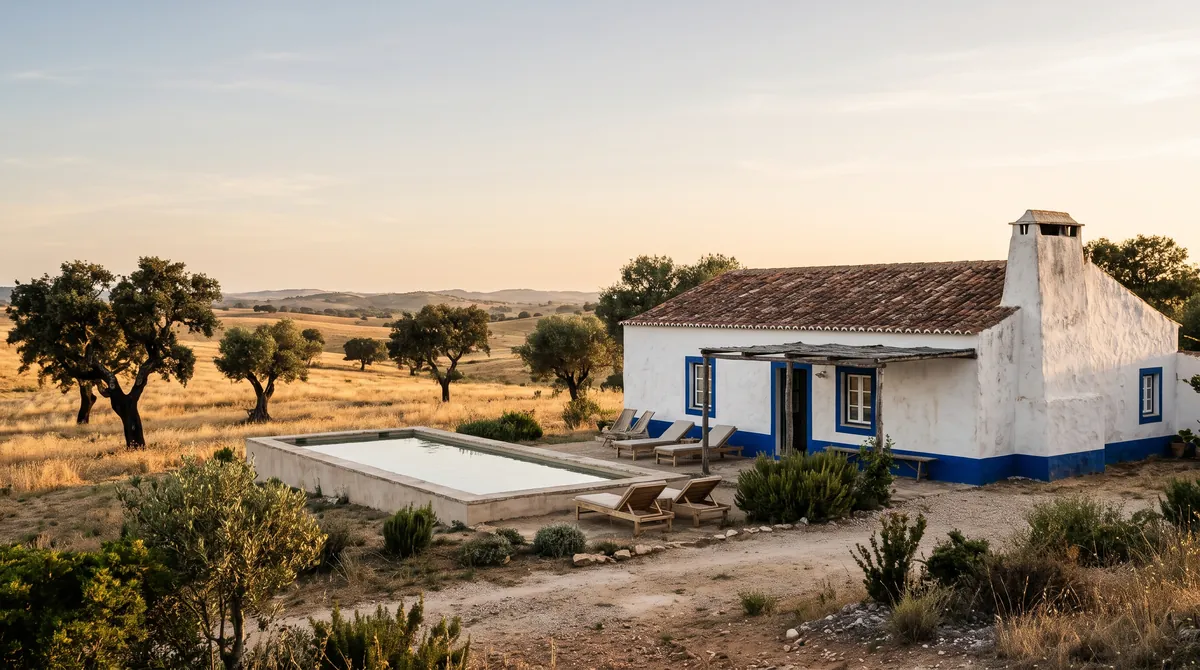
In the Alentejo the sky does most of the talking. The land rolls away in long, low waves, gold in summer and green after the winter rain, dotted with dark, rounded cork oaks that cast pools of shade. A white farmhouse sits on a rise, a blue band painted around its doors and windows. In the afternoon nothing moves except a bird of prey turning slowly overhead and the shadows of the oaks creeping across the stubble. You came for a rest, and the landscape takes the hint.
A region the size of a small country
The Alentejo is Portugal’s largest region, spreading south of the river Tagus towards the Algarve and east to the Spanish border. It is a land of rolling plains, olive groves, vineyards and the open woodland of cork oak and holm oak that the Portuguese call montado. Villages are few and far apart, and the towns are whitewashed, their houses edged in blue or yellow. Distances look short on the map and feel long on the road, partly because you keep stopping to look.
This is not a region for ticking off sights. It rewards a slower rhythm: one base, a few short drives, long lunches and evenings outside. Whatever you planned, plan a little less.
Herdade or monte: choosing where to sleep
Two words come up again and again when you look for a country stay. A herdade is a large rural estate, often with its own olive groves, cattle, vines or cork woodland, and sometimes so large that the drive from the gate to the house takes several minutes on a dirt track. A monte is a farmhouse on a hill, traditionally the heart of a smaller farm, built low and thick-walled to keep the heat out.
Both make lovely retreats, but they suit different moods. A herdade usually offers more space, walks straight from the door and the feeling of having the horizon to yourself. A converted monte tends to be more intimate, with a handful of rooms around a courtyard and the owners often living on site. Small country houses here are frequently family homes, so a little patience at breakfast goes a long way.
Before you book, check a few practical things:
- How far is the nearest village with a café and a shop? Out here it can easily be 15 km or more.
- Is the access road paved, or a dirt track that turns slow and muddy after rain?
- Is there a pool, or an old irrigation tank for swimming, and is it shaded in the afternoon?
- Can dinner be served on site, so that you are not driving unlit country roads after dark?
- Are the rooms cooled by thick walls alone, or is there air conditioning for July and August?
Living with the heat
Summers in the Alentejo are very hot, and the heat shapes the day. Local life follows a sensible pattern: work and errands early, shutters closed in the middle of the day, and the streets filling again when the air softens. Copy it. Walk or explore before eleven in the morning, spend the hottest hours in a cool room or by the water, and go out again after six in the evening.
Old farmhouses help. Their walls are thick, the windows are small, and the rooms stay surprisingly cool even when it is fierce outside. Carry water in the car, wear a hat, and remember that water is precious here: short showers and a towel used twice are a small courtesy to a dry land. Spring, with wildflowers across the plains, and autumn, golden and mild, are the ideal seasons.
The cork oak and the montado
Portugal is the world’s largest producer of cork, and much of it grows in the Alentejo. Cork oaks are protected, and their bark is stripped by hand about every nine years, leaving the trunk a startling rusty red that slowly darkens again. Many trees carry a painted number, the last digit of the year the bark was taken, so the next harvest can be planned. Once you know to look for it, you see it everywhere.
The montado is more than a cork plantation. Sheep and cattle graze beneath the trees, black pigs root for acorns in autumn and winter, and the open woodland is full of birds. It is a farmed landscape that has stayed beautiful because it is farmed with patience.
It is a farmed landscape that has stayed beautiful because it is farmed with patience.
Évora, Monsaraz and Marvão
Évora is the natural day out from much of the central Alentejo. Its historic centre has been a UNESCO World Heritage Site since 1986, and within its walls you find a Roman temple, whitewashed lanes and the chapel of bones, whose walls are lined with human bones and skulls: strange, sobering and unforgettable. Go in the morning, before the heat, and stay for a long lunch.
To the east, Monsaraz is a small walled village on a hill above the Alqueva lake, a place of a few cobbled streets, a castle and wide views over the water. Further north, close to the Spanish border, Marvão sits on a granite crag, its walls running along the edge of the rock and the view reaching far across the plains into Spain. Both villages are at their best at the end of the day, when the visitors have gone. People live behind those doors, so keep voices low in the lanes at night.
Stars over Alqueva
The Alqueva area has been certified as a Starlight Tourism Destination for its dark skies, and on a moonless night the Milky Way stretches clearly across the sky above any terrace well away from the villages. You need nothing more than a blanket, a warm layer and 20 minutes for your eyes to adjust. Check the moon before you book if stargazing matters to you: a full moon lights the plains beautifully but hides the fainter stars.
Bread soup, black pork and a song
Alentejo food is generous and rooted in the land. Açorda, a bread soup with garlic, coriander, olive oil and a poached egg, sounds humble and tastes wonderful. Black pork from pigs raised in the montado, sheep’s cheese and the region’s wines complete the picture, and lunch tends to last as long as the shade.
If you are lucky, you will also hear cante alentejano, the region’s polyphonic singing, on the UNESCO list of intangible cultural heritage since 2014. Groups of singers perform slowly and without instruments, in deep, layered voices that seem made for wide spaces. Performances are often small and local, so your hosts are the best people to ask.
Questions and answers
When is the best time to visit the Alentejo?
Spring and autumn are ideal: spring brings wildflowers across the plains, autumn mild and golden days. Summers are very hot, so if you travel then, plan outings for the early morning and evening and choose a stay with a pool and shade.
What is the difference between a herdade and a monte?
A herdade is a large rural estate, often with farmland, woodland or vineyards around it. A monte is a farmhouse on a hill, usually smaller and more intimate. Many of both have been converted into country retreats.
Do I need a car?
Yes. Country estates are often reached by long tracks, villages are far apart and public transport is limited. Keep a full tank and plenty of water in the car, especially in summer.
Where can I see the dark skies?
The Alqueva area, around the lake below Monsaraz, is certified as a Starlight Tourism Destination. Any terrace away from village lights works well on a moonless night.
Further reading in our network
- vinorinaWine regions of Europe
A guide to the wine regions of Europe, with the grapes, cellars and landscapes behind each glass.
- PalmianaTravel journal
A travel journal of stories and destinations for curious travellers who like to take their time.
Our articles are general travel information written with care. Opening months, access and local rules change; check the details with your hotel before you travel.