
Sleeping in history: convents, palaces and manor houses in Portugal
Cloisters, chapels, painted ceilings and gardens of camellias: Portugal has made an art of hospitality in historic buildings. How pousadas and manor house stays work, and what to ask before you book.
The door is heavy oak, studded with iron, and above it a coat of arms has been weathered almost smooth by the rain. Inside, the hall smells of beeswax and old stone. A wide granite staircase leads up to a corridor of dark portraits, and from your window you look down on a garden of clipped box hedges and camellias, glossy and deep green, with a fountain ticking softly in the middle. Somewhere a clock strikes the hour. You have not so much checked into a hotel as been received into a house.
A long tradition of historic stays
Portugal has a long tradition of hotels in historic buildings, and few countries make it so easy to sleep in a castle, a convent or a palace. Part of the reason is history itself: the country is full of grand buildings that outlived their original purpose, from monasteries without monks to manor houses whose estates had shrunk. Turning them into places to stay has kept many of them alive, lived in and cared for.
Two systems are worth knowing before you plan, because they lead to quite different experiences: the pousadas, and the manor house stays known as turismo de habitação. Add the former convents that have become hotels, and you have a whole country to explore one historic bedroom at a time.
The pousadas: castles, convents and palaces
The pousadas are a network of hotels in castles, convents, monasteries and palaces, created by the Portuguese state in the 1940s. They are spread across the country, from the green north to the plains of the Alentejo, and each is shaped by the building it occupies. In a former monastery the cloister may become the breakfast terrace; in a castle you may sleep behind battlements, looking out over the countryside the walls were built to watch.
Because they are found in so many regions, pousadas lend themselves to a journey: a night in a castle, two in a convent, one in a palace, each a different chapter of Portuguese history. Service follows hotel lines, which suits travellers who like a reception desk, a restaurant and the freedom to come and go.
Turismo de habitação: a guest in a family home
Turismo de habitação is an official category for stays in manor houses and historic family homes, often still lived in by the family. It is especially common in the north, in the Minho region around Ponte de Lima, an old town on the river Lima with a long stone bridge. Here the welcome is personal: the owner may meet you at the door, show you the chapel and tell you which great-grandmother planted the camellias.
The house is often a solar, the manor house of the landed gentry, with a coat of arms over the door, a private chapel and formal gardens. Rooms are furnished with family pieces, carved wooden beds and old prints, and breakfast is often served in the dining room at set times. It is intimate, particular and full of stories. It also asks something of you: a little flexibility and the manners you would bring to a friend’s house.
A few courtesies make the stay easier for everyone:
- Tell your hosts roughly when you will arrive; there may be no reception desk, and someone will be waiting for you.
- Ask before wandering into the private rooms of the house or the chapel.
- Keep evenings quiet, especially in rural houses where sound carries across the courtyard.
- Ask whether dinner can be arranged, since many houses do not serve it and the nearest village may be some distance away.
- Accept the offer of a tour if it comes; the stories are often the best part of the stay.
Convents and monasteries: the beauty of silence
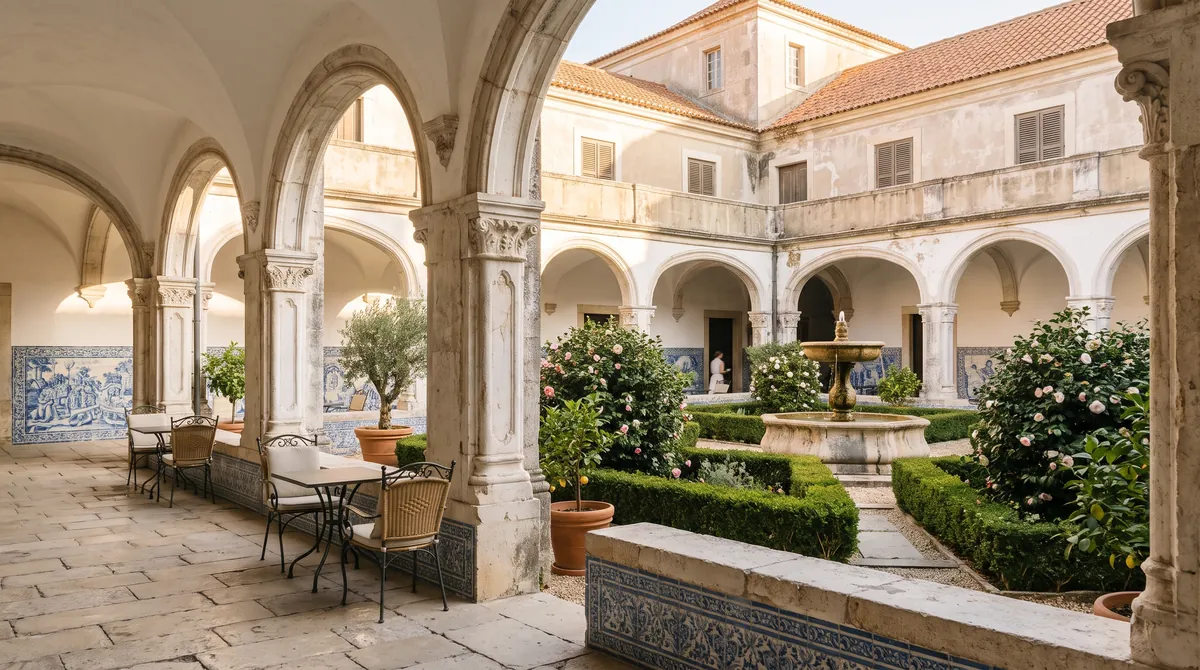
Many convents were dissolved in the nineteenth century, and their buildings were later converted to other uses, some of them to hotels. Staying in one has a particular quality. Corridors are long and vaulted, rooms are sometimes former cells joined together, and the cloister at the centre, with its arcades and fountain, becomes the quiet heart of your day.
Look out for the details: azulejos lining the walls in blue and white, painted ceilings in former chapels and refectories, stone steps worn into hollows by centuries of feet. Rise early at least once and walk the cloister before anyone else is up, when the only sounds are the swallows and the water.
You have not so much checked into a hotel as been received into a house.
What is different in a historic building
Historic stays are full of beauty and full of compromise, and it helps to know which is which. Rooms can differ greatly in size, light and outlook, even under the same roof: a grand room with a painted ceiling may sit next to a narrow former cell. Historic buildings may have stairs and no lift, uneven floors and low doorways. On the other hand, thick walls mean quiet rooms, cool in summer, and you will rarely sleep better.
| Type of stay | What it is | What to expect | What to ask |
|---|---|---|---|
| Pousada | A hotel in a castle, convent, monastery or palace, part of a network created by the state in the 1940s | Hotel service in a historic setting | Which rooms are in the historic part and which in a newer wing |
| Turismo de habitação | An official category for stays in manor houses and historic family homes | A personal welcome, family furniture, few rooms | Whether dinner is served, and at what time breakfast is |
| Solar | The manor house of the landed gentry, with coat of arms, chapel and gardens | Formal rooms and gardens with camellias and box hedges | Whether guests may see the chapel and walk in the gardens |
| Former convent | A religious house dissolved in the nineteenth century and later converted | Cloisters, vaulted corridors, simple rooms | How large the room is, and whether it looks onto the cloister |
Where to go: four regions
The Minho, in the green north west, is the heartland of manor house stays, with granite houses among the vineyards of vinho verde, the light, fresh ‘green wine’ of the region, and gardens where camellias flower from late winter into spring. The Douro, further east, adds wine estates on terraced slopes above the river. In the Beiras you find granite villages on hilltops, sturdy and grey, where a night in an old house feels like stepping back a century. And in the Alentejo, convents and palaces in whitewashed towns offer cool cloisters and shaded courtyards against the summer heat.
A good journey links two or three of these regions, with one historic stay in each. Two nights per house is the sensible minimum: on the first evening you are a visitor, by the second you begin to feel at home.
Questions and answers
What is a pousada?
A pousada is a hotel in a historic building such as a castle, convent, monastery or palace. The network was created by the Portuguese state in the 1940s and reaches many regions of the country.
What does turismo de habitação mean?
It is an official category for stays in manor houses and historic family homes, often still lived in by the family. The welcome is personal and the number of rooms is usually small.
Are historic hotels suitable for guests with limited mobility?
Not always. Historic buildings may have stairs and no lift, uneven floors and steps between rooms. Ask the house directly about access before you book.
Are rooms in historic buildings quiet?
Usually very. Thick stone walls keep out noise and heat, so rooms are calm and cool. The bells of a nearby church may be the only interruption.
Further reading in our network
- HotelrisHotel magazine
A hotel magazine about remarkable places to stay and the world of hospitality behind them.
Our articles are general travel information written with care. Opening months, access and local rules change; check the details with your hotel before you travel.